
Understanding the Four Competitive Swimming Strokes
Competitive swimming features four primary strokes: freestyle, backstroke, breaststroke, and butterfly. Each stroke has its own technique, rhythm, and race strategy, requiring swimmers to master different body movements, breathing patterns, and timing. Together, these strokes form the foundation of competitive swimming and are featured in individual events, relays, and medley competitions.
Learning the strengths and challenges of each stroke helps swimmers improve their overall performance while developing versatility in the pool.
Freestyle: The Fastest Swimming Stroke
Freestyle is the fastest and most commonly used stroke in competitive swimming. Although swimmers may technically use any stroke during freestyle events, the front crawl is almost always chosen because of its speed and efficiency.
The stroke involves alternating arm movements combined with a continuous flutter kick. Swimmers rotate their bodies naturally while turning their heads to the side for breathing. Efficient body position and smooth arm recovery help reduce water resistance, making freestyle the preferred stroke for sprint and long-distance races.
Backstroke: Speed While Swimming on the Back
Backstroke is the only competitive stroke performed while lying on the back. Swimmers use alternating arm movements similar to freestyle, along with a steady flutter kick to maintain momentum.
Since the face remains above the water, breathing is unrestricted, allowing swimmers to focus on rhythm and stroke efficiency. Maintaining a streamlined body position is essential, while starts begin from inside the pool using the starting wall rather than the diving block.
Breaststroke: Precision and Timing
Breaststroke is known for its unique combination of simultaneous arm movements and a powerful frog-style kick. Unlike freestyle and backstroke, every movement must be carefully synchronized to maximize efficiency and maintain forward momentum.
Timing plays a crucial role, as swimmers glide briefly after each stroke cycle before repeating the movement. While breaststroke is generally the slowest of the four competitive strokes, it demands exceptional coordination, balance, and technical precision.
Butterfly: Power and Coordination
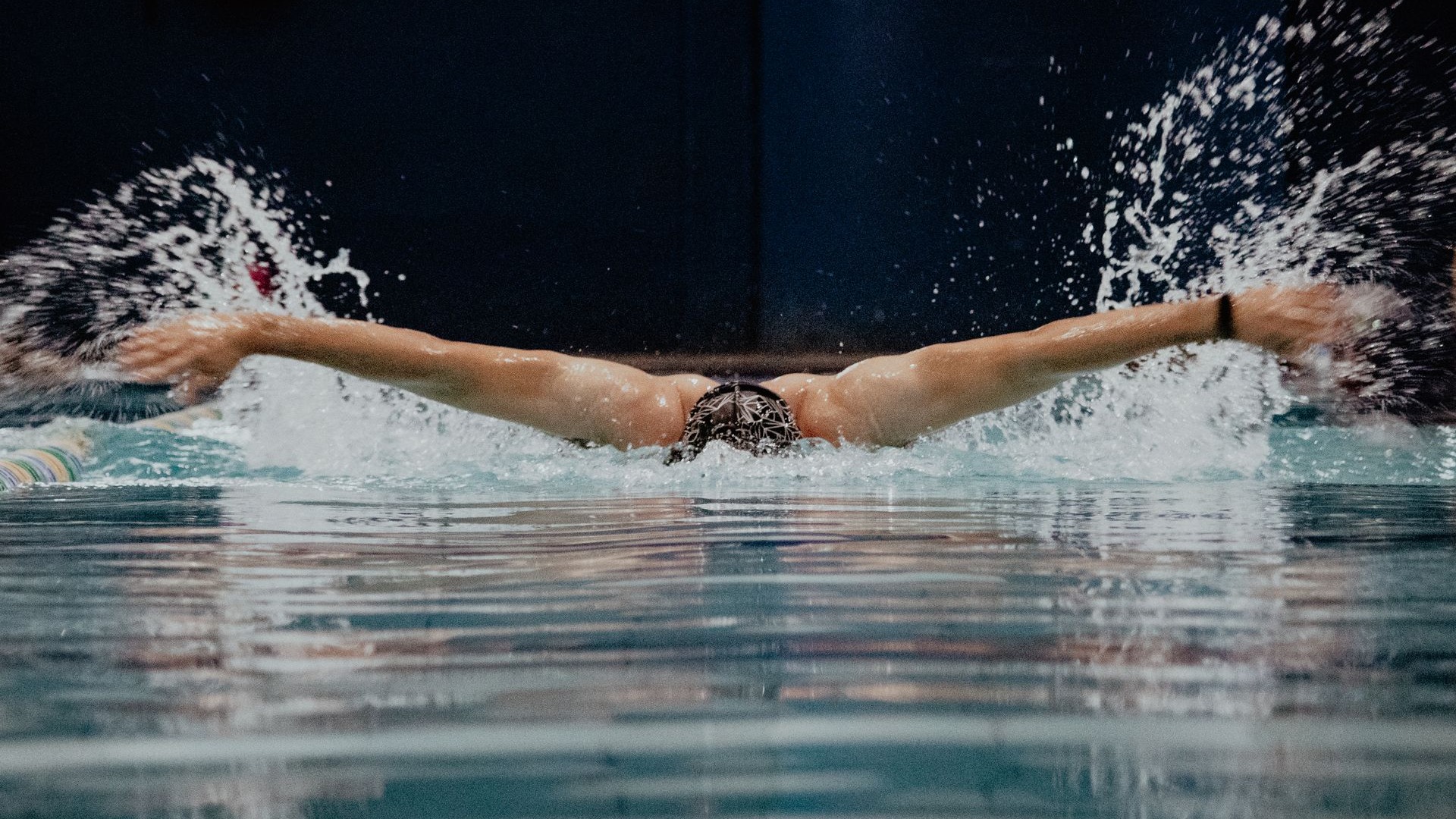
Butterfly is widely regarded as the most physically demanding competitive swimming stroke. Both arms move simultaneously over the water while the body performs a wave-like motion supported by two dolphin kicks during each stroke cycle.
This stroke requires significant upper-body strength, core stability, endurance, and precise timing. Maintaining rhythm throughout the race is essential, as even small technical errors can quickly reduce speed and increase fatigue.
Although butterfly requires considerable physical effort, it is also one of the most visually impressive events in competitive swimming due to its powerful and synchronized movements.
Choosing the Right Stroke
Each swimming stroke places different demands on the body and develops specific skills. Freestyle emphasizes speed and endurance, backstroke improves body alignment and shoulder mobility, breaststroke focuses on timing and coordination, while butterfly develops explosive power and overall strength.
Many competitive swimmers train in all four strokes to improve versatility, especially those competing in individual medley and medley relay events.
Mastering Technique for Better Performance
Success in competitive swimming depends on more than physical fitness. Proper technique, consistent practice, and expert coaching help swimmers refine every aspect of their stroke, from body position and breathing to starts and turns.
Whether training for local competitions or international championships, mastering the four competitive swimming strokes provides the foundation for long-term improvement and success in the sport.